
CFC Administration in 2026: Substance Evaluation Criteria and the Tax Health Check Algorithm


Nataliia Ushkan,
Transfer Pricing Analyst
Table of Contents
State Tax Service Reveals Initial Results of the CFC Reporting Campaign
The State Tax Service has released figures from the reporting campaign on controlled foreign companies for the 2025 tax year. The overarching conclusion is that businesses have stopped staying in the shadows. The game of hide-and-seek with the state has officially concluded, making transparency a baseline prerequisite for operations.
As of May 1, 2026, controlling persons have submitted 19,045 reports on the activities of their foreign companies. This clearly demonstrates that business has adapted to CFC rules and maintains reporting discipline before the tax authorities.
- 9,343 – under the full reporting form;
- 9,702 – under the abbreviated reporting form.
Tax analytics clearly outlined the geographical footprint and flow of Ukrainian capital. There are few surprises: Poland leads by company volume, while Switzerland holds substantial capital reserves.
Here is how Ukrainian beneficial owners distributed their choice of jurisdictions:
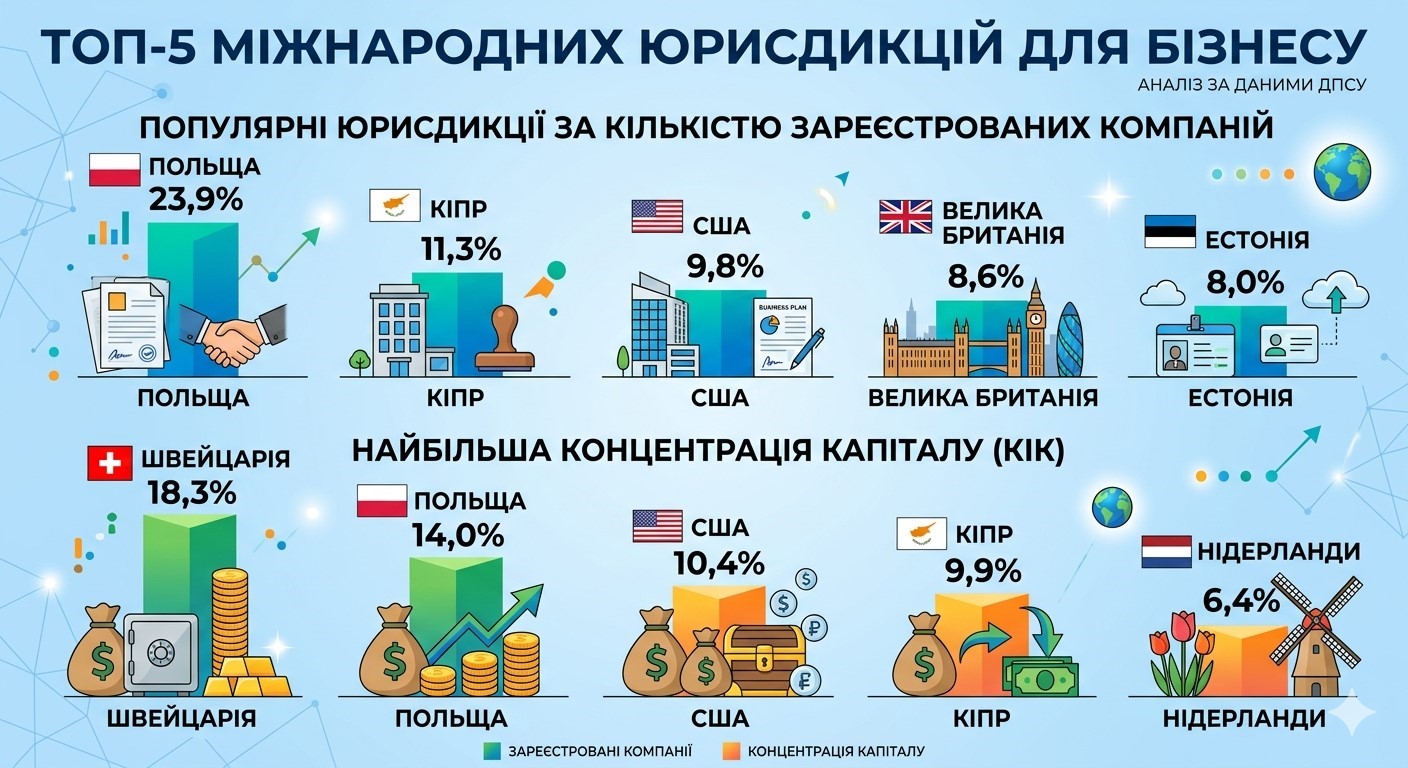
Important: The ongoing campaign is still active. Those who filed CFC declarations under the abbreviated form have until the end of 2026 to submit complete documentation packages. Final figures will therefore be even higher.
Analysis by the State Tax Service highlighted a remarkable development: Ukrainian owners of foreign corporations actively and fully lawfully utilize statutory exemptions to exempt CFC profits from domestic taxation.
Top Grounds for Tax Exemption According to STS Data (https://www.tax.gov.ua/media-tsentr/novini/1014521.html):
✓ Conducting active business abroad (where passive income ≤ 50%, provided an applicable double taxation treaty or tax information exchange agreement is in force) – leveraged by 53.0% of companies.
✓ Presence of real operational substance (where passive income ≥ 50%, provided an applicable double taxation treaty or tax information exchange agreement is in force) – selected by 22.6% of taxpayers.
✓ 6.2% – public company status, where foreign corporate stock is admitted to trading on a recognized exchange approved by the Cabinet of Ministers of Ukraine.
✓ 3.6% – total aggregate revenue across all CFCs of a single controlling person does not exceed €2 million.
✓ 1.4% – effective corporate income tax rate paid abroad is ≥ 13% (with an applicable double taxation or exchange agreement in effect).
✓ Combination of multiple statutory criteria – 13.2% of companies.
STS Stance on Reporting Errors: Rules Have Tightened
The STS has substantially tightened its administrative handling of CFC filings. Per recent official guidance (Individual Tax Consultation No. 1450/IPK/99-00-24-03-03 of March 13, 2026), simply recalling or cancelling a CFC Report is technically impossible. Rectifying an error now entails: submitting formal explanations via the Electronic Cabinet, filing a mandatory clarifying report, and lodging an amended personal income tax declaration (or corporate profit tax return).
Expert Tip: Review every figure and checkbox in your CFC Report multiple times before hitting submit. The cost of a simple technical error today is an automatic “high-risk” classification inside the tax service’s automated audit registry.
The greatest exposure lies with taxpayers relying on evaluative statutory criteria. Foremost among these is Substance (economic presence) — the second most frequent exemption basis, claimed by 22.6% of Ukrainian beneficial owners.
What Substance Means and Why It Is Vital
The concept of Substance (Economic Presence / Economic Essence) refers to the verifiable set of operational markers confirming genuine commercial operations within the country of incorporation. It stems from the foundational international principle of “substance over form,” codified in the Tax Code of Ukraine, OECD standards, and the EU ATAD Directive.
Modern automated STS analytical tools no longer accept “paper” holding vehicles. Holding a tax residency certificate from a foreign jurisdiction is insufficient on its own — tax inspectors examine whether an active commercial business stands behind the corporate registration.
Four Pillars of Substance: What the STS Looks For:
| Area | What the Tax Authority Inspects | Evidentiary Documentation |
|---|---|---|
| Office & Infrastructure | Presence of a physical (non-virtual) lease of commercial workspace. Furnishings, office IT hardware, dedicated internet, and phone connectivity. | Commercial lease agreement, utility bills, premises handover acceptance acts, photographic records of active workstations. |
| Personnel | Qualified payroll staff who are tax residents of the incorporation country. Market-level wages and local social tax remittances. | Employment contracts, payroll statements, local social security administration returns. |
| Governance (Mind & Management) | Where strategic business decisions are authoritatively adopted. Real qualifications and autonomous decision-making power of directors (no nominee arrangements). | Board meeting minutes with substantive agendas, official business correspondence, electronic signature log files, and online banking IP login history. |
| Cash Flows | Sound commercial rationale for intra-group transactions. Absence of conduit or pass-through fund transfers. | Loan agreements with arm’s-length interest terms, complete bank statements, prepared transfer pricing documentation. |
Hallmarks of a “Shell Company” — Red Flags for the STS
During automated filing screenings and desk audits, STS systems monitor for the following markers of non-genuine business activity:
- Mass Registration Address: The legal entity shares a single address (corporate letterbox) with hundreds of unrelated entities.
- Nominee Directors: A local corporate provider or lawyer formally heads dozens of companies concurrently and cannot articulate the commercial rationale of daily operations.
- Absence of Operating Expenses: Financial statements record solely annual corporate maintenance and auditor fees, showing no outlays for telecom, advertising, workplace rental, staff, or technical infrastructure.
- Conduit Cash Movements: Capital arrives in the account and is transferred out in full within 1–3 business days to other group affiliates or beneficial owners.
- Management from Ukraine: Online banking administration originates entirely from Ukrainian IP addresses, while day-to-day managerial directions are issued via personal messaging apps.
- Unsecured Interest-Free Loans: Financing provided without security or at below-market interest rates, defying commercial rationale and indicating disguised dividend distributions (a direct violation of the arm’s length principle).
Case Study: Substance for a Cyprus Entity — Moving from Paper to Operational Reality:
Cyprus continues to serve as a key jurisdiction for Ukrainian corporate holding structures. However, local substance rules have changed fundamentally as a result of comprehensive tax reforms enacted as of January 1, 2026. Domestic standards are now strictly aligned with the EU ATAD Directive and OECD frameworks.
The CIGA (Core Income-Generating Activities) rule under BEPS Action 5 has taken central importance. Preferential regimes (including the 3% IP Box regime or dividend participation exemptions) are only sustained if the company carries out the primary revenue-generating activities directly on Cypriot territory.
Key Legal Warning: Holding a physical Cypriot Tax Residency Certificate does not confer automatic treaty entitlement. To apply reduced withholding rates under Ukrainian tax treaties (5% for dividends, 2% for interest), the foreign company must qualify as the Beneficial Owner of the income — which cannot be established without genuine Substance.
Holding a valid Cypriot Tax Residency Certificate does not grant an automatic right to treaty relief in Ukraine. To apply reduced withholding tax rates on cross-border payments (5% dividends, 2% interest), the foreign recipient must qualify as the Beneficial Owner of the income. In current STS audit practice and Ukrainian judicial precedent, defending this status without documented operational substance (physical office and staff) is legally unsustainable.
Substance Checklist for a Cyprus Company
| Status | Requirement | Supporting Documentation |
|---|---|---|
| ✓ | Majority of directors are resident in Cyprus with genuine executive powers | Passports, Cyprus Tax Identification Numbers (TIN), employment/consulting contracts, professional CVs |
| ✓ | Board of Directors meetings take place physically in Cyprus (at least quarterly) | Signed Board Minutes outlining authentic commercial agendas, flight tickets, hotel accommodation records |
| ✓ | Dedicated physical office space (not a virtual shell): active lease and utility billing | Commercial lease agreement, utility payment receipts, premises photographs |
| ✓ | At least 1–2 full-time payroll employees who are Cyprus residents earning market salaries | Employment agreements, social insurance payment returns (GESY contributions) |
| ✓ | Bank account operations authorized and managed from Cypriot IP addresses | Online banking access logs (showing IP address, timestamp, location), dedicated corporate VPN profiles |
| ✓ | Absence of pass-through transactions: the company retains an arm’s-length operating margin and pays local corporate tax | Bank account statements, audited statutory financial reports, Cyprus corporate tax return |
| ✓ | Primary source records, accounting books, and company seals kept on-site in Cyprus | Document custody transfer certificate, formal confirmation from the registered office provider |
| ✓ | Intra-group loan financing complies strictly with arm’s-length transfer pricing requirements | Transfer pricing local file, economic benchmarking study |
Action Plan: Conducting a Tax Health Check for Your Structure
The audit algorithm below covers key verification areas monitored by the State Tax Service across the 2026–2027 enforcement cycle. It is recommended to perform this review annually — prior to the close of the financial year, rather than after receiving a tax inquiry.
Step 1. Economic Test (Assessment of Exemption Criteria)
- Calculate passive vs. active income proportions for each CFC during the current fiscal year;
- Determine the effective foreign corporate tax rate (factoring in applicable local deductions and exemptions);
- If passive revenues exceed 50%, evaluate operational mechanisms to rebalance the income ratio before year-end.
Step 2. Substance Scoring (Audit of Corporate Viability)
- Audit each foreign entity against the substance checklist;
- Assess whether the appointed director can substantively demonstrate personal involvement and articulate business rationale;
- Audit historical electronic banking connection IP logs.
Step 3. Transaction Review (Intra-Group Flows)
- Intercompany debt financing audit: are interest rates benchmarked to market arm’s-length standards?
- Review distributions to directors: are payments commercially supported, or do they risk reclassification as hidden dividends?
- Review transactions between foreign CFCs and domestic Ukrainian operating entities for transfer pricing exposure.
Step 4. Assembling the Defense File (Substantiating Your Tax Position)
A Defense File is a pre-assembled evidence binder ready for presentation upon the start of a tax audit or in response to an official inquiry. It should include:
- Active office commercial lease agreement and utility payment receipts;
- Employment contracts with local staff, payroll records, and proof of social insurance contributions (e.g., Cyprus GESY filings);
- Professional resumes (CVs) of management personnel demonstrating domain expertise;
- Signed Board meeting minutes detailing genuine business deliberations over the preceding 2–3 years;
- Underlying commercial documents with counterparties: executed agreements, invoices, acceptance acts, and corporate email correspondence records;
- Transfer pricing documentation covering related-party transactions (including economic benchmarking reports).
Core Risk Rule: Proactive compliance is the only viable business approach today. A preventive Tax Health Check, genuine operational Substance, and an assembled Defense File protect international structures against penalties and CFC tax reassessments. Do not wait for an inquiry from the tax authorities — resolve exposures beforehand.

Audit Invest provides end-to-end support: non-resident transaction screening, Report on Controlled Transactions, and complete transfer pricing documentation packages.